Debt-to-Income Ratio Explained: How Lenders Use DTI for Mortgage Qualification
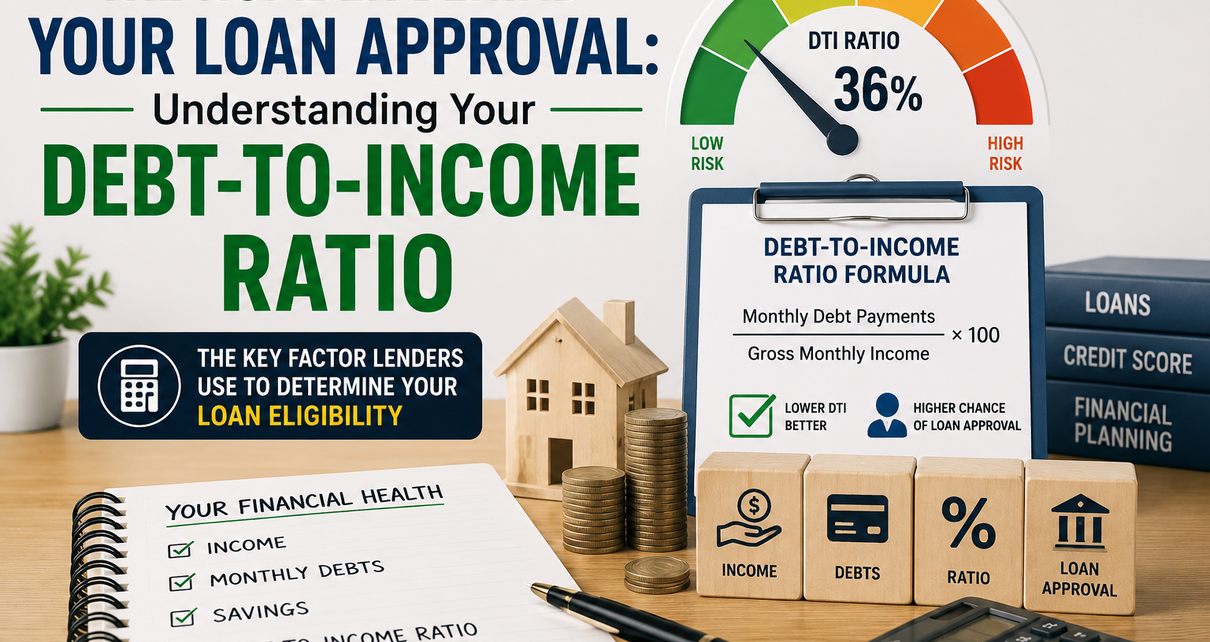
When you are preparing to buy a home, one of the most important numbers a lender may examine is your debt-to-income ratio, commonly known as DTI.
Debt-to-income ratio helps lenders compare your monthly debt obligations with your income. It can play an important role in determining how much you may be able to borrow and how much of a monthly housing payment you may qualify for.
However, DTI is only one part of the mortgage process. There is much more involved in evaluating a home loan than simply looking at one percentage.
Understanding how lenders use DTI can nevertheless make the mortgage process much easier to understand. It can also help you determine what type of monthly payment fits your financial goals before you begin shopping for a home.
What Is Debt-to-Income Ratio?
A lender generally looks at two different debt-to-income ratios when evaluating a mortgage application:
- Front-end DTI
- Back-end DTI
Your front DTI compares your housing expense with your income.
Your back DTI compares your housing expense plus your other monthly debts with your income.
The back DTI therefore provides a broader picture because it considers both the proposed housing payment and other debt obligations.
Other debts can include payments associated with things such as credit cards, car loans, and student loans.
Although DTI is important, it is not the only factor considered in a mortgage application. The mortgage process involves many different elements, and DTI is one part of the overall lending decision.
Start With Your Home-Buying Goals
Before focusing entirely on DTI, it is important to understand what you actually want to accomplish with your home purchase.
A good starting point is to contact a lender and get pre-approved before you find a house.
Waiting until you have already found a property before beginning the loan process can create unnecessary problems. Starting earlier gives you an opportunity to understand your financial position and determine what type of financing may fit your situation.
The first part of the process should involve discussing your goals.
For example, you may already know:
- The neighborhood where you want to live
- The approximate price range of homes you are considering
- The monthly payment you can comfortably afford
- How much money you have available for a down payment
These details are important because mortgage financing should be built around your goals rather than simply around the maximum amount a lender is willing to approve.
Once your goals and financial information are understood, different loan options can be considered to determine which ones best fit your financial profile.
Why Your Maximum Qualification Is Not Always Your Ideal Budget
One of the most important distinctions in the mortgage process is the difference between what you can qualify for and what you actually want to spend.
A lender may determine that your financial situation allows you to qualify for a particular monthly payment.
But that does not mean you have to spend that much.
For example, suppose your debt-to-income ratio allows a maximum housing payment of $3,500 per month.
If your personal goal is to keep your housing payment at or below $3,000, then your own budget may be more restrictive than the lender’s maximum qualification.
In that situation, the fact that you could technically qualify for a higher payment may not matter.
Your personal financial goals should remain an important part of the process.
The maximum amount a lender is willing to approve is not necessarily the amount you should spend.
How Automated Underwriting Uses DTI
Once the lender understands your goals and financial information, automated underwriting systems can be used to evaluate different loan scenarios.
For a conventional loan, the transcript discusses automated underwriting systems associated with Fannie Mae and Freddie Mac.
Fannie Mae’s system is called Desktop Underwriter (DU), while Freddie Mac’s system is called Loan Product Advisor (LPA).
These systems can be used to test different scenarios and determine the limits within which a loan may qualify.
The lender can strategically run different scenarios and examine the results to determine the maximum debt-to-income ratio that may work for the particular loan situation.
In other words, the process can help establish a financial guardrail.
The lender may determine a maximum front-end DTI or, more commonly, a maximum back-end DTI.
Once that maximum DTI is identified, it can be used to calculate how much a borrower may qualify to borrow for a property.
An Example of Using a 45% Back-End DTI
Consider an example where the automated underwriting system allows a maximum 45% back-end DTI.
Suppose the borrower has:
- $10,000 in monthly income
- $1,000 in other monthly debt payments
The other debt could include payments such as credit cards, car payments, and student loans.
The next question is:
How much can this borrower spend on a house?
To answer that question, the calculation can be broken into four basic steps:
- Calculate the maximum total monthly payment.
- Calculate the amount available for principal and interest.
- Calculate the maximum loan amount.
- Calculate the maximum purchase price.
Let’s walk through each step.
Step 1: Calculate the Maximum Total Payment
The borrower has $10,000 in monthly income.
The maximum back-end DTI is 45%.
To determine the maximum amount of total monthly debt payments, multiply:
$10,000 × 45% = $4,500
This means the borrower’s total monthly debt payments can be up to $4,500 under the example’s DTI limit.
But the borrower already has $1,000 in other monthly debt.
Therefore, that $1,000 must be subtracted from the $4,500 maximum.
$4,500 − $1,000 = $3,500
This leaves a maximum housing payment of $3,500.
Lenders refer to this payment as PITI.
What Does PITI Mean?
PITI stands for:
- Principal
- Interest
- Taxes
- Insurance
When applicable, PITI can also include mortgage insurance and homeowners association dues.
This is important because the entire $3,500 housing payment is not necessarily available to pay the mortgage loan itself.
Part of the payment may have to cover property taxes, homeowners insurance, mortgage insurance, or HOA dues.
Therefore, the next step is to separate those expenses from the amount available for principal and interest.
Step 2: Calculate the Principal and Interest Payment
Imagine the $3,500 monthly PITI payment as a pie.
The entire pie represents the maximum monthly housing payment.
Before determining how large the mortgage loan can be, portions of that $3,500 need to be allocated to other housing-related expenses.
For this example, suppose:
- Property taxes are $6,000 per year.
- Homeowners insurance is $1,200 per year.
- There are no HOA dues.
- The borrower is making a 20% down payment.
- Therefore, mortgage insurance is not included in the example.
The annual property tax of $6,000 equals:
$6,000 ÷ 12 = $500 per month
The annual homeowners insurance of $1,200 equals:
$1,200 ÷ 12 = $100 per month
The maximum PITI is $3,500.
Subtract the $500 monthly property tax:
$3,500 − $500 = $3,000
Then subtract the $100 monthly homeowners insurance:
$3,000 − $100 = $2,900
This leaves $2,900 per month available for principal and interest.
So although the borrower may qualify for a $3,500 total housing payment, only $2,900 of that amount is available for the actual mortgage principal and interest under this example.
Step 3: Convert the Monthly Payment Into a Loan Amount
The next step is to determine how much money the borrower could potentially borrow with a $2,900 principal-and-interest payment.
For this example, assume:
- A 30-year loan
- A 6.5% interest rate
- 12 payments per year
- A monthly principal-and-interest payment of $2,900
Using an amortization calculation with these assumptions results in a loan amount of approximately $459,000.
This is an important step because the DTI calculation does not simply produce a purchase price.
Instead, the DTI helps establish the maximum payment, which can then be used to determine the potential loan amount.
Step 4: Calculate the Maximum Purchase Price
Now that the example produces a maximum loan amount of approximately $459,000, the next step is to determine the corresponding purchase price.
The borrower is making a 20% down payment.
That means the mortgage represents 80% of the home’s purchase price.
This percentage is known as the loan-to-value ratio, or LTV.
With a 20% down payment:
LTV = 80%
To determine the purchase price, divide the loan amount by the LTV:
$459,000 ÷ 0.80 = approximately $574,000
Therefore, under this example, the borrower could potentially qualify for a purchase price of approximately $574,000 with a 20% down payment.
This illustrates how lenders can work backward from a DTI limit to determine the maximum potential housing payment, loan amount, and purchase price.
Why the Maximum PITI Matters
A pre-approval letter may make it appear as though you are approved for a specific purchase price and loan amount.
However, it is important to understand the underlying calculation.
The actual limiting factor may be the maximum PITI payment.
This becomes especially important when you are shopping near the upper end of your qualification range.
A property may have a purchase price that appears to fit within your pre-approved amount, but the property could have additional expenses that change the calculation.
One major example is a homeowners association fee.
How HOA Fees Can Change Your Maximum Purchase Price
Let’s use the same example.
The borrower previously had a maximum PITI of $3,500.
The original calculation assumed:
- $500 per month for property taxes
- $100 per month for homeowners insurance
- No HOA dues
- No mortgage insurance because of the 20% down payment
That left $2,900 for principal and interest.
Now imagine the borrower finds a townhome with a $300 monthly HOA fee.
The maximum PITI remains $3,500.
But the monthly expenses that must come out of that amount have changed.
The calculation now becomes:
$3,500 − $500 taxes − $100 insurance − $300 HOA = $2,600
That leaves only $2,600 per month for principal and interest.
The maximum mortgage payment has therefore decreased from $2,900 to $2,600.
How a Higher HOA Fee Changes the Loan Amount
Using the same 30-year loan and 6.5% interest-rate assumptions, a $2,600 principal-and-interest payment produces a lower maximum loan amount.
Under the example, the resulting loan amount falls to approximately $411,000.
This is a significant difference from the previous approximately $459,000 loan amount.
The HOA fee did not change the borrower’s income.
It did not change the original DTI limit.
Instead, the HOA fee consumed part of the maximum PITI payment, leaving less money available for principal and interest.
How the HOA Fee Changes the Maximum Purchase Price
The borrower is still making a 20% down payment, meaning the loan-to-value ratio remains 80%.
The maximum loan amount is now approximately $411,000.
To calculate the corresponding purchase price:
$411,000 ÷ 0.80 = approximately $513,000
The maximum purchase price therefore falls from approximately $574,000 to approximately $513,000.
This example demonstrates why understanding the maximum PITI is so important.
A property that appears affordable based solely on its purchase price may not actually fit within the borrower’s qualification limits once property taxes, insurance, HOA dues, and other applicable costs are included.
Purchase Price Alone Does Not Tell the Whole Story
It can be tempting to look at a property’s purchase price and compare it with your pre-approval amount.
But the purchase price is only part of the calculation.
Two homes with the same purchase price can have different monthly costs.
Property taxes can differ.
Insurance costs can differ.
One property may have HOA dues while another does not.
Mortgage insurance can also affect the total payment depending on the down payment.
All of these expenses can affect the amount available for the principal and interest portion of the mortgage.
That is why understanding PITI and DTI together can be useful when evaluating how much home you can qualify for.
What If Your Personal Budget Is Lower Than Your DTI Limit?
There is another important point to remember: your maximum DTI qualification does not have to become your target budget.
Suppose your financial profile allows a $3,500 monthly PITI payment.
But you have decided that you want to keep your housing payment below $3,000.
In that case, your personal goal is more conservative than the maximum allowed by the loan guidelines.
The lender can focus on finding a financing structure that keeps the payment within your preferred limit.
This distinction can prevent a common misunderstanding about mortgage pre-approval.
Being approved for a certain amount does not mean that you should necessarily spend that amount.
Your own goals and financial comfort level matter.
DTI Is a Tool, Not the Entire Mortgage Decision
Debt-to-income ratio can be extremely important in the mortgage process, but it is not the only consideration.
The transcript emphasizes that there is much more to every loan than DTI.
The reason DTI receives so much attention is that it helps establish a relationship between income, existing debt, and the proposed housing payment.
It provides a framework that lenders can use to determine whether a particular loan scenario fits within applicable limits.
Automated underwriting can then be used to test different scenarios and establish the maximum DTI that may work.
Once that limit is known, the lender can work backward to determine the maximum payment and potential loan amount.
Why You Should Get Pre-Approved Before Shopping
Getting pre-approved before looking seriously at homes can help you understand your financing position before you become emotionally attached to a property.
Instead of finding a home first and then discovering whether the financing works, you can begin with an understanding of your income, debts, goals, down payment, and potential loan options.
This allows the financing strategy to be built around your circumstances.
It can also make it easier to understand the difference between the maximum amount you may qualify for and the amount you actually want to spend.
What Happens If Your DTI Is Too High?
A high debt-to-income ratio can limit the amount you may qualify to borrow.
The transcript’s example demonstrates that the maximum DTI establishes the total amount of debt payments that can fit within the calculation.
If existing debts already consume a significant portion of your allowable DTI, there may be less room for a new housing payment.
Similarly, additional housing expenses such as HOA dues can reduce the amount available for principal and interest.
This means that even relatively small changes to monthly obligations can affect the maximum loan amount.
The Relationship Between DTI, PITI, Loan Amount, and Purchase Price
The mortgage qualification process can be viewed as a chain of calculations.
First, income and the maximum allowable DTI determine the maximum total monthly debt payment.
Next, existing debts are deducted to determine the maximum PITI available for the housing expense.
Then property taxes, homeowners insurance, HOA dues, and applicable mortgage insurance are deducted from the PITI.
The amount remaining becomes the maximum principal-and-interest payment.
That payment can then be converted into a potential mortgage loan amount based on the interest rate and loan term.
Finally, the loan amount can be used with the loan-to-value ratio to calculate a potential purchase price.
The process can therefore be summarized as:
Income → DTI → Maximum PITI → Principal & Interest → Maximum Loan Amount → Maximum Purchase Price
Understanding this sequence makes it easier to see why the maximum purchase price is not determined by income alone.
Final Thoughts
Debt-to-income ratio is an important part of understanding mortgage qualification.
Lenders generally look at both front-end DTI and back-end DTI. The front DTI focuses on housing expenses compared with income, while the back DTI considers housing expenses together with other monthly debts.
The process can then use a maximum DTI to establish a maximum total monthly payment.
From there, the calculation becomes more detailed.
Property taxes, homeowners insurance, mortgage insurance, and HOA dues may all take up part of the maximum PITI payment. Whatever remains can be used toward principal and interest.
That principal-and-interest payment can then be converted into a potential loan amount based on the interest rate and loan term. Finally, the loan amount can be used with the loan-to-value ratio to estimate the maximum purchase price.
The example demonstrates how a borrower with $10,000 in monthly income, $1,000 in other monthly debts, and a 45% back-end DTI could arrive at a $3,500 maximum PITI payment. After accounting for taxes and insurance, $2,900 could remain for principal and interest, resulting in an approximately $459,000 loan and a purchase price of about $574,000 with a 20% down payment.
But adding a $300 monthly HOA fee changes the calculation. The amount available for principal and interest falls to $2,600, reducing the potential loan amount to approximately $411,000 and the maximum purchase price to approximately $513,000.
This is why understanding DTI alone is not enough. You also need to understand how the total housing payment is constructed.
Most importantly, the maximum amount a lender allows is not necessarily the amount you should spend. If your personal goal is to keep your monthly payment below the maximum qualification amount, your mortgage strategy should reflect that goal.
A mortgage pre-approval should therefore be viewed as a financing framework rather than simply a green light to spend the maximum possible amount.
By understanding your income, existing debts, DTI, PITI, loan-to-value ratio, and the additional costs associated with a property, you can get a much clearer picture of how mortgage qualification works and why the same purchase price can produce very different financial outcomes depending on the property’s expenses.