Student Loan Repayment Plans in 2026: RAP, SAVE Changes, and What Borrowers Need to Know
Student loan repayment rules are changing significantly in 2026.
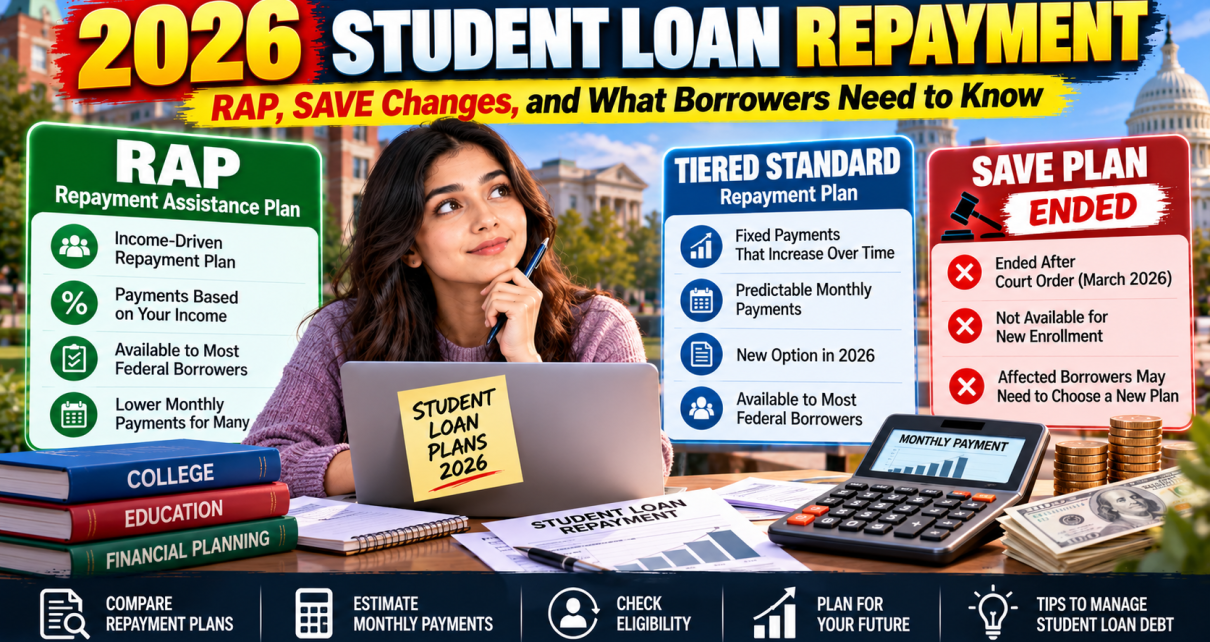
For federal student loan borrowers, one of the biggest developments is the introduction of the Repayment Assistance Plan, commonly called RAP. At the same time, the SAVE Plan is no longer available following a federal court order, meaning borrowers who were enrolled in SAVE or had pending SAVE applications need to move to another eligible repayment plan.
The new rules can be confusing because eligibility depends on factors such as the type of federal loan you have, when the loan was first disbursed, your income, your dependents, and whether you are pursuing programs such as Public Service Loan Forgiveness.
This guide explains the major Student Loan Repayment Plans in 2026, how RAP works, what happened to SAVE, and what borrowers should check before changing their repayment plan.
What Is the Repayment Assistance Plan?
The Repayment Assistance Plan, or RAP, is a new income-driven repayment plan for eligible federal student loan borrowers.
Unlike a traditional fixed-payment plan, RAP bases the borrower’s payment partly on income and the number of dependents.
Under RAP, the basic calculation uses a percentage of adjusted gross income, or AGI, divided by 12. The applicable percentage increases as income increases, ranging from 1% to 10% depending on the borrower’s AGI.
The payment is then reduced by $50 for each dependent claimed on the borrower’s federal tax return, subject to a minimum monthly payment of $10.
In simplified form:
RAP monthly payment = applicable percentage of AGI ÷ 12 − $50 per dependent
The final payment cannot be less than $10.
This makes RAP different from older income-driven repayment plans that use discretionary income formulas.
The exact payment should be calculated through the official Federal Student Aid repayment tools because the applicable percentage and eligibility depend on the borrower’s individual circumstances.
Who Can Use RAP in 2026?
RAP is available for eligible federal Direct Loan borrowers, but not every federal student loan qualifies.
Current Federal Student Aid guidance says RAP is available for most Direct Loans, including eligible Direct Subsidized Loans, Direct Unsubsidized Loans, and Direct PLUS Loans made to graduate or professional students.
Parent PLUS loans are not eligible for RAP. Certain Direct Consolidation Loans involving Parent PLUS loans also have special restrictions.
Loan disbursement dates also matter.
If all of a borrower’s loans were first disbursed on or after July 1, 2026, RAP is the only income-driven repayment plan available to that borrower, subject to the applicable eligibility rules.
Borrowers with loans disbursed before July 1, 2026 may have more than one repayment option depending on their loan type and history.
This means two borrowers with similar balances can have different repayment-plan choices.
Before changing plans, borrowers should check their StudentAid.gov account to identify their loan types, disbursement dates, current repayment plan, and available options.
How Is the RAP Monthly Payment Calculated?
RAP uses adjusted gross income as the starting point for its payment calculation.
The applicable percentage depends on the borrower’s AGI.
The base percentage ranges from 1% to 10% across different income levels.
For example, the RAP structure currently uses these AGI bands:
AGI of $10,000 or less: $120 annual base payment
More than $10,000 to $20,000: 1% of AGI
More than $20,000 to $30,000: 2% of AGI
More than $30,000 to $40,000: 3% of AGI
More than $40,000 to $50,000: 4% of AGI
More than $50,000 to $60,000: 5% of AGI
More than $60,000 to $70,000: 6% of AGI
More than $70,000 to $80,000: 7% of AGI
More than $80,000 to $90,000: 8% of AGI
More than $90,000 to $100,000: 9% of AGI
More than $100,000: 10% of AGI
The applicable annual amount is divided by 12 to establish the basic monthly payment before the dependent adjustment.
This is important because RAP should not be described simply as “paying 10% of your income.” The percentage depends on the borrower’s AGI range.
How Dependents Affect RAP Payments
RAP includes a specific adjustment for dependents.
The borrower’s monthly payment is reduced by $50 for each dependent claimed on the borrower’s federal tax return.
However, the payment cannot fall below $10 per month.
For example, suppose the calculated RAP payment before the dependent adjustment is $250 per month and the borrower has two qualifying dependents.
The dependent adjustment would reduce the payment by $100:
$250 − $100 = $150
The resulting payment would therefore be $150 per month, assuming all other RAP requirements are satisfied.
If the dependent adjustment would reduce the calculated payment below $10, the monthly payment would still be at least $10.
This feature makes family size an important part of RAP.
Married Borrowers and RAP
Married borrowers need to pay attention to how their tax filing status can affect the payment calculation.
When married borrowers file a joint federal tax return, the repayment calculation can take household income into account under the RAP rules.
When married borrowers file separately, the calculation generally uses the borrower’s own income and the dependents they claim on their federal tax return.
There can also be situations where a spouse has federal student loans, which can affect the final payment calculation.
Because tax filing decisions can have consequences beyond student loans, borrowers should not choose married-filing-jointly or married-filing-separately status solely because of the student loan calculation.
Taxes, credits, deductions, income, and other household circumstances can all affect the overall result.
If the difference is significant, consider discussing the tax implications with a qualified tax professional.
RAP and Interest: What Happens When Your Payment Is Too Low?
One major feature of RAP is its treatment of unpaid interest.
Under an income-driven repayment plan, a borrower’s required payment can sometimes be lower than the amount of interest accruing on the loan.
For example, imagine that $300 of interest accrues during a month but the borrower’s required RAP payment is only $200.
Without an interest protection feature, the difference could potentially leave unpaid interest on the account.
RAP provides an interest subsidy for qualifying borrowers who make their full, on-time monthly payment.
If the monthly payment is less than the interest that accrued for that month, the unpaid interest after the required payment is subsidized under the RAP rules.
This feature is important because it is designed to prevent borrowers who are making their required full and on-time payments from being overwhelmed by unpaid interest.
However, borrowers should understand that making a payment under RAP does not mean the loan balance automatically falls by the amount of the payment.
Interest and principal are separate parts of the loan balance.
RAP’s Matching Principal Payment
RAP also includes a matching principal payment.
Under the plan, if a borrower’s full and on-time monthly payment does not reduce the principal balance by at least $50, the Department of Education can provide a matching principal payment of up to $50.
The purpose is to help ensure that qualifying borrowers make progress toward reducing principal even when their required monthly payment is relatively low.
Consider a simplified example.
Suppose a borrower makes the required monthly payment on time, but after the interest is accounted for, only $25 of the borrower’s payment would reduce principal.
Under the RAP matching-payment provision, an additional payment can be made to ensure that the principal reduction reaches the applicable $50 threshold, subject to the program’s rules.
This feature is separate from the interest subsidy.
The interest subsidy addresses qualifying unpaid interest.
The matching principal payment helps support principal reduction.
Together, these features are intended to make progress toward reducing the loan balance more predictable for borrowers making full, on-time RAP payments.
How Long Does RAP Last?
RAP has a 30-year repayment period.
If the borrower has not repaid the loan in full after making the equivalent of 360 qualifying monthly payments, any remaining balance can be forgiven under the plan’s rules.
Thirty years is a long repayment period.
Therefore, borrowers should not think of RAP forgiveness as a short-term solution.
A borrower could potentially spend decades making qualifying payments before reaching the end of the repayment period.
The total amount paid over the life of the loan can also be important when comparing repayment plans.
A lower monthly payment does not automatically mean a lower total cost.
That is why borrowers should compare the estimated monthly payment, repayment period, total interest, projected balance, and potential forgiveness before selecting a plan.
RAP and Public Service Loan Forgiveness
Borrowers working toward Public Service Loan Forgiveness, commonly known as PSLF, should pay close attention to repayment-plan eligibility.
Federal Student Aid states that full and on-time payments made under an eligible IDR plan can count toward PSLF when the borrower also meets the other PSLF requirements.
RAP payments can therefore be relevant to borrowers pursuing PSLF.
However, being enrolled in RAP by itself does not guarantee PSLF forgiveness.
PSLF also involves requirements concerning qualifying employment and other program rules.
Borrowers pursuing PSLF should track their qualifying employment and payments through the official Federal Student Aid system rather than assuming that every payment will automatically qualify.
What Happened to the SAVE Plan in 2026?
One of the biggest changes borrowers need to understand is that the SAVE Plan is no longer available.
A federal court order ended the Saving on a Valuable Education, or SAVE, Plan in March 2026.
Federal Student Aid now states that SAVE is no longer available to borrowers.
This means borrowers who were enrolled in SAVE or had a pending SAVE application need to select another repayment plan.
Borrowers affected by the end of SAVE should watch for communications from their loan servicer and check their StudentAid.gov account.
Do not assume that an old SAVE payment amount or SAVE status will continue indefinitely.
The repayment options available to you depend on your loan type and when your loans were first disbursed.
RAP vs. SAVE: What Borrowers Need to Know
RAP and SAVE should not be treated as two currently available alternatives.
SAVE has ended.
RAP is a new income-driven repayment option available under the 2026 federal student loan changes.
This distinction matters because older articles and online discussions may still describe SAVE as though borrowers can currently enroll in it.
That information can now be outdated.
Borrowers researching repayment options should pay attention to the publication date of any article they read.
For current federal student loan information, StudentAid.gov should be treated as the primary source for determining available plans and eligibility.
What If You Are Currently on SAVE?
If you were enrolled in SAVE, do not simply assume that your existing plan will remain available.
Federal Student Aid says borrowers enrolled in SAVE or with pending SAVE applications must choose a new repayment plan.
Your loan servicer may contact you with instructions and a deadline.
The exact deadline can vary depending on when you receive the applicable notice.
The practical steps are:
Log in to StudentAid.gov.
Check your current repayment plan and loan information.
Review the repayment options available to your loans.
Use the official Repayment Calculator to compare plans.
Read communications from your loan servicer.
Apply for a new eligible repayment plan when required.
Keep records of your application and confirmation.
Borrowers should be particularly careful about relying on social-media posts or old articles because repayment rules are changing quickly during 2026.
Which Repayment Plans Are Available in 2026?
RAP is not the only repayment option available.
Depending on your loan type and when the loan was first disbursed, you may have access to other plans, including Income-Based Repayment and certain older repayment plans.
The new Tiered Standard Repayment Plan is also part of the 2026 federal student loan changes.
For borrowers with eligible loans, the Tiered Standard Plan uses fixed repayment periods of 10, 15, 20, or 25 years depending on the amount owed.
This means borrowers should not automatically assume that an income-driven plan is the only option.
A fixed-payment plan may produce a different monthly payment and total repayment cost.
The correct comparison depends on your individual loan balance, income, loan type, family situation, and long-term goals.
Why Your Loan’s Disbursement Date Matters
One of the most important details in the 2026 repayment changes is the date your loan was first disbursed.
Federal Student Aid uses loan type and disbursement date when determining which repayment plans may be available.
For example, borrowers with loans first disbursed on or after July 1, 2026 face a different IDR-plan landscape from borrowers whose loans were first disbursed before that date.
If you have loans from different periods, you may have a mixture of eligibility rules.
This is why simply searching online for “best student loan plan” may not give you a useful answer.
The plan available to another borrower may not be available to you.
Start by checking your own StudentAid.gov Dashboard.
How to Compare Student Loan Repayment Plans
Before selecting a plan, compare more than the monthly payment.
Look at:
Monthly payment
Repayment period
Total amount paid
Total interest
Potential forgiveness
PSLF implications
Loan eligibility
Future income changes
Family size
Tax implications of potential forgiveness
For example, Plan A might have a lower monthly payment but require payments for a longer period.
Plan B might have a higher monthly payment but result in less total interest.
A borrower pursuing PSLF may also evaluate plans differently from a borrower who expects to repay the entire balance personally.
The goal is not simply to find the smallest payment.
The goal is to understand how the payment fits into the borrower’s broader financial situation.
Use the Federal Student Aid Repayment Calculator
Federal Student Aid provides a Repayment Calculator that can help borrowers compare available repayment options.
The calculator can show information such as estimated monthly payments, repayment periods, total amounts paid, and potential forgiveness.
When logged into StudentAid.gov, borrowers can also use their actual federal loan information to make the comparison more personalized.
This is generally more useful than relying on a generic online calculator because your loan type and history can affect eligibility.
Borrowers can also provide authorization for Federal Student Aid to retrieve certain federal tax information from the IRS for the application process.
If your financial circumstances have changed significantly, review whether updated income information can be used to request a recalculation of your payment.
Annual Income and Family-Size Recertification
Income-driven repayment does not mean your monthly payment remains permanently fixed.
Borrowers generally need to recertify their income and family size or number of dependents once each year.
Federal Student Aid allows borrowers to view their recertification date through their StudentAid.gov account.
Missing the required recertification can have consequences, including a higher payment if the loan is no longer being calculated using the income-driven formula.
For this reason, borrowers should not treat enrollment in an IDR plan as a one-time task.
It is an ongoing responsibility.
A useful habit is to check your StudentAid.gov account periodically and keep your contact information current with your loan servicer.
What If Your Income Changes?
Your financial situation may change after you enroll in an income-driven repayment plan.
You could lose your job, receive a significant raise, change jobs, get married, have a child, or experience another change in family circumstances.
Federal Student Aid states that borrowers can submit updated information when their current payment does not reflect their situation.
For example, a borrower who has recently experienced a significant reduction in income may be able to request a recalculation rather than waiting for the next annual recertification.
This can be particularly important when the existing payment is no longer affordable.
Do not wait until you miss payments before exploring your available options.
What About Parent PLUS Loans?
Parent PLUS borrowers need to be particularly careful when researching repayment options.
Parent PLUS Loans are not eligible for RAP.
Certain consolidation scenarios involving Parent PLUS loans also have special restrictions.
Federal Student Aid states that borrowers with only current Parent PLUS loans are not eligible for an IDR plan. However, some borrowers who previously consolidated Parent PLUS loans into a Direct Consolidation Loan before July 1, 2026 may have different options.
Because Parent PLUS rules can be complicated, borrowers should check their exact loan history rather than relying on a general RAP eligibility statement.
Student Loan Repayment Changes in 2026: A Simple Checklist
If you have federal student loans, use this checklist to review your situation:
Check your StudentAid.gov Dashboard.
Identify each federal loan type.
Check when each loan was first disbursed.
Confirm your current repayment plan.
If you were on SAVE, check whether you need to select a new plan.
Review whether RAP is available for your loans.
Compare RAP with other eligible repayment plans.
Use the official Repayment Calculator.
Check your income and dependent information.
Review your IDR recertification date.
Consider whether PSLF is part of your long-term strategy.
If married, understand how your tax filing status affects the repayment calculation.
Keep records of applications and communications from your servicer.
Avoid companies that charge fees for basic federal student loan assistance that is available directly through StudentAid.gov.
Common Mistakes Borrowers Should Avoid
Mistake 1: Assuming SAVE Is Still Available
SAVE ended in 2026.
Do not assume an old article or previous payment calculation still applies.
Mistake 2: Choosing a Plan Only Because It Has the Lowest Monthly Payment
A low monthly payment can be helpful for cash flow, but it may come with a longer repayment period.
Look at the total repayment cost as well.
Mistake 3: Ignoring Your Loan Type
Not every federal loan qualifies for every repayment plan.
Check your actual loan information.
Mistake 4: Forgetting About Annual Recertification
Income-driven plans generally require annual updates.
Missing the deadline can cause problems.
Mistake 5: Ignoring Changes in Income
If your income falls substantially, your current payment may no longer reflect your financial situation.
Check whether you can request a recalculation.
Mistake 6: Assuming RAP Forgiveness Is Automatic After 30 Years
RAP provides a 30-year repayment period, but borrowers must satisfy the applicable requirements for qualifying payments.
Do not treat forgiveness as an automatic guarantee simply because 30 calendar years have passed.
Mistake 7: Making a Tax Decision Only to Reduce Student Loan Payments
Married borrowers may see different payment calculations depending on tax filing status.
But tax filing affects more than student loans.
Consider the complete tax and household picture.
Student Loan Repayment Plans in 2026: Key Takeaways
RAP is a new income-driven repayment plan introduced in 2026.
RAP payments are based on a percentage of adjusted gross income, divided by 12, with a $50 monthly reduction for each dependent claimed on the federal tax return.
The RAP payment cannot be less than $10 per month.
The applicable AGI percentage ranges from 1% to 10% depending on income.
RAP includes an interest subsidy for qualifying borrowers who make their full, on-time payments.
RAP also includes a matching principal payment of up to $50 when the borrower’s payment does not reduce principal by at least $50.
RAP has a 30-year repayment period, or 360 qualifying monthly payments.
SAVE ended in March 2026 following a federal court order and is no longer available.
Borrowers affected by the end of SAVE need to select another eligible repayment plan.
Loan type and first-disbursement date are important when determining repayment-plan eligibility.
Parent PLUS loans have special restrictions and are not eligible for RAP.
Borrowers pursuing PSLF should evaluate how their repayment plan fits with PSLF requirements.
The Federal Student Aid Repayment Calculator is an important tool for comparing available plans.
Final Thoughts
Student loan repayment in 2026 looks different from previous years.
The introduction of RAP and the end of SAVE have changed the repayment landscape for millions of federal student loan borrowers.
RAP is designed around income and family circumstances, with payments based on AGI and adjusted for dependents. It also includes an interest subsidy and matching principal payment for qualifying borrowers who make full, on-time payments.
At the same time, borrowers should not assume that RAP is automatically the right plan for everyone.
Your loan type, disbursement date, income, family situation, tax filing status, PSLF goals, and expected ability to repay can all affect the decision.
The end of SAVE makes it especially important for current borrowers to verify their repayment status rather than relying on older information.
If you are affected by the SAVE transition, log in to StudentAid.gov, check your current plan, review your available options, and use the official Repayment Calculator before making a change.
Student loan rules can change, and individual eligibility can be complicated. For that reason, use current information from StudentAid.gov and your loan servicer when making an actual repayment decision.
The most important step is not simply choosing a repayment plan. It is understanding how that plan affects your monthly payment, total repayment, potential forgiveness, and long-term financial goals.